Direct answer
For most Japanese maples, choose a glazed oval or soft rectangle in a quiet, cool color — deep indigo, muted blue-grey or pale celadon — roughly two-thirds the height of the tree in length, with a depth close to the thickness of the trunk. Avoid red and bright glazes that repeat the foliage: contrast, not repetition, is what makes autumn color look vivid.
Key takeaways
- A pot should contrast the maple's loudest feature, not repeat it. Red foliage over a red pot reads as one mass and dulls both.
- Deep indigo and muted blue intensify autumn red; pale celadon suits summer foliage; unglazed warm earth suits the leafless winter silhouette.
- Japanese maples read as refined, "feminine" trees in Japanese display convention — ovals and soft-cornered rectangles suit them better than hard, masculine forms.
- Size before color: length about two-thirds of tree height, depth about equal to trunk caliper. A beautiful glaze in the wrong proportion still fails.
- Acer palmatum is an outdoor species for roughly USDA zones 5–8. Confirm the tree can live where you live before you spend on the vessel.
01 — THE PRINCIPLE
Contrast makes
color visible.
In autumn, a Japanese maple already carries the loudest color in the composition. The pot does not need to say it again.
Matching a red tree with a red vessel can feel intuitive. But when both elements speak at the same volume, the outline between them weakens: tree and vessel begin to read as one red mass, and the eye has nowhere to rest. This is the most common first mistake we see in maple compositions bought online.
A quieter pot gives the foliage an edge. Deep blue, muted green, warm earth or charcoal each create enough distance for seasonal color to appear brighter — without adding another subject to the composition.
Do not ask which pot repeats the tree.
Ask which pot lets the tree arrive first.
02 — FOUR GLAZE DIRECTIONS
Four quiet
answers.
No color is universally correct. Bark, season, display setting and the character of the individual tree still decide. These are starting directions — not rules.
For luminous autumn red.
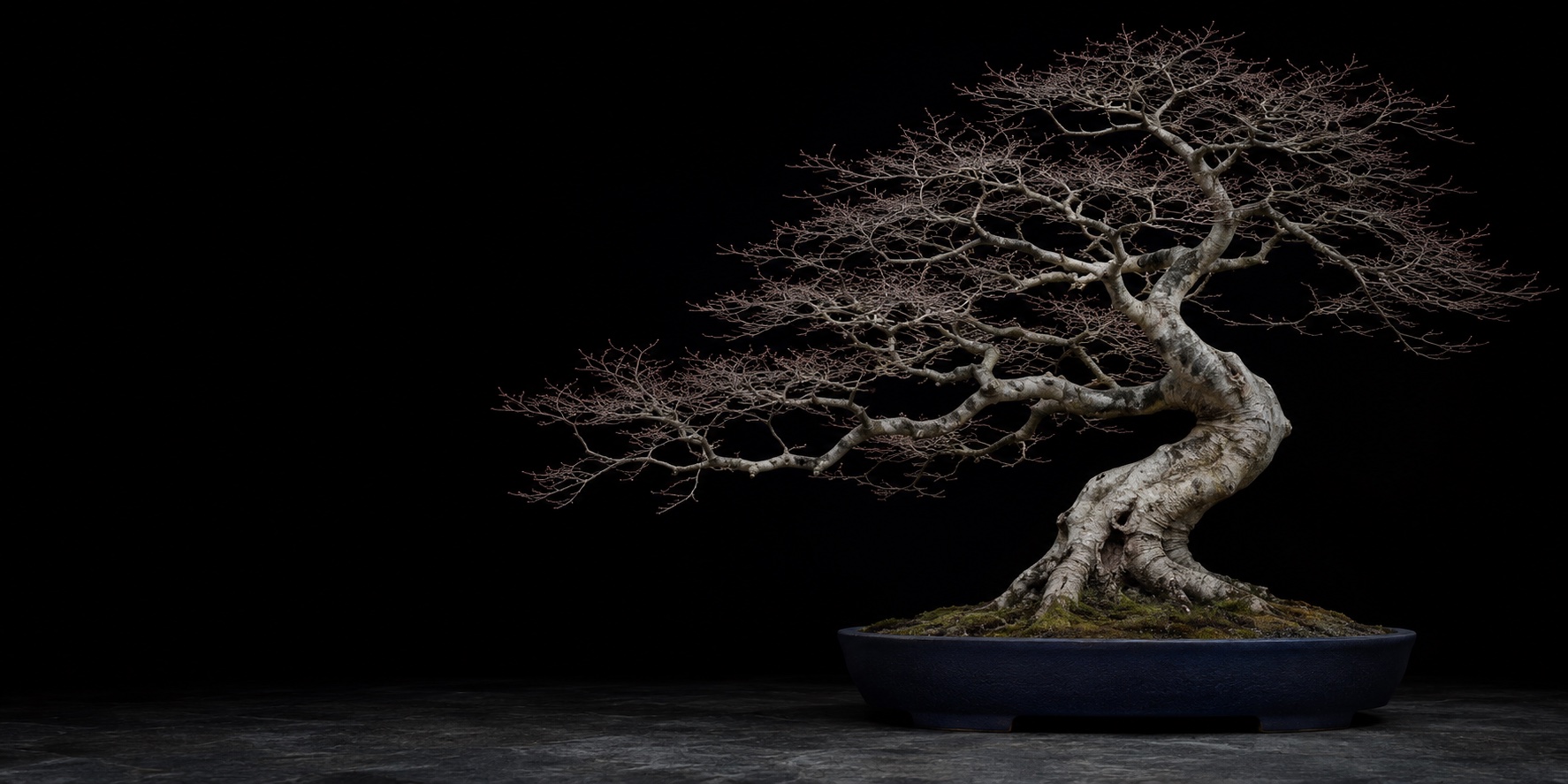
A dark blue glaze creates cool distance beneath scarlet foliage. Best when the pot form is simple and the blue is almost black.
For summer lightness.
Muted green can echo living foliage without copying it. A soft oval suits fine ramification and a lighter visual character.
For winter structure.
When leaves fall, bark and branch become the composition. Unglazed clay can support age without introducing another color.
For restraint all year.
Charcoal recedes. It is useful when the trunk has enough presence to carry the composition without help from glaze.
| Glaze | Strongest season | What it does | Avoid when |
|---|---|---|---|
| Deep indigo / near-black blue | Autumn | Cool distance under red and orange foliage; makes scarlet appear brighter | The display backdrop is already dark blue or black-glazed |
| Pale celadon / muted green | Spring–summer | Echoes fresh foliage one step quieter; keeps a light, airy character | Autumn display — green next to red can look seasonal-card literal |
| Unglazed warm earth (brown, reddish clay) | Winter | Supports bark and silhouette without adding color; ages honestly | The tree is young and smooth-barked, with little structure to show |
| Soft charcoal / slate grey | All year | Recedes completely; hands the whole composition to the tree | The tree itself is visually quiet and needs the pot's support |
| Bright red, orange, strong yellow | — | Competes with foliage at the same temperature; outline between tree and pot weakens | Almost always, for this species |
Matrix compiled by the JAPAN BONSAI EDIT editorial team from Japanese display convention and our own composition studies. Treat it as a starting judgment, not a law — an individual tree can overrule any row.
03 — SHAPE AND SIZE
Proportion before
everything.
In Japanese display convention, trees are read along a spectrum from masculine — heavy trunk, rough bark, strong angles — to feminine: smooth bark, fine branching, gentle curves. Most Japanese maples sit clearly on the refined end. The pot should agree.
That is why ovals and soft-cornered rectangles dominate serious maple display, while hard, deep rectangles with strong lips stay under pines and junipers. A drum pot can work for a broad, aged maple; a severe cut-corner rectangle almost never does.
Size rules of thumb used across Japanese nursery practice:
Fits a Japanese maple
- Oval, length about ⅔ of the tree's height
- Soft rectangle with rounded corners, low lip
- Depth roughly equal to trunk diameter at the base
- Glazed, in the quiet directions above
- Slightly wider pot for cascade-light or wide canopies
Rarely fits
- Bright red, orange or high-gloss glazes that repeat foliage
- Deep, massive rectangles with aggressive lips
- Ornate painted pots competing for attention
- Pots so shallow the root mass cannot establish
- Any pot chosen before confirming the tree's health
Depth matters horticulturally as well as visually: maples are thirsty, fine-rooted trees, and a pot with some volume buffers summer watering. If you must err, err slightly deep while the tree is in development, and move to the display pot once ramification matures.
04 — CLIMATE FIRST
The living tree
comes first.
A beautiful composition begins with a healthy tree. Acer palmatum is an outdoor species: university extension guidance places it in roughly USDA hardiness zones 5–8, with cultivar differences at both ends.[1][2] It needs a real winter dormancy and will decline indoors.
At the warm end of the range, leaf scorch is the practical limit: in hot summers, leaves burn unless the tree has afternoon shade or steady water.[1] Check your zone on the USDA Plant Hardiness Zone Map before buying the tree — and before spending on the vessel.[3]
Climate → tree health → horticultural fit → proportion → color.
05 — THREE WAYS TO CHOOSE
Three honest
paths.
These are not a ranking. They are three different relationships with the same standard.
Japanese Masterpiece
A signed Tokoname or artist pot.
Tokoname, one of Japan's six ancient kilns, has supplied serious bonsai pots for generations; the craft is formally designated a traditional industry of Aichi Prefecture.[4][5] For a maple, look for a glazed oval from a named kiln or artist, with the maker's seal on the base.
- Look for
- Maker's seal, even glaze, clean feet, drainage holes cut cleanly
- Expect to pay
- US$300 and far upward for signed work; antiques higher
- Where
- Specialist Japanese pot dealers and auction specialists — verify the seal before paying collector prices
Local Artisan Choice
A thrown pot from a potter near you.
North America, the UK and Europe all have ceramicists making bonsai pots to a serious standard. A local artisan oval in a muted glaze gives you the same aesthetic logic, lower shipping risk, and a maker you can actually talk to.
- Look for
- High-fired stoneware, frost-safe if you overwinter outdoors, true drainage
- Expect to pay
- Roughly US$80–300 depending on size and maker
- Where
- Potters' own sites, bonsai club sales, specialist ceramics fairs
First Practice
A production glazed oval, sized right.
For a first maple, a well-made production pot in deep blue or celadon is the rational choice. Spend the saved money on the tree's health — soil, wire, a second season. The pot can be upgraded; a dead tree cannot.
- Look for
- Correct length (⅔ of tree height), real drainage holes, no crazing
- Expect to pay
- Roughly US$30–80
- Where
- Established bonsai retailers in your country — see our note on buying bonsai online in the USA
EDITORIAL NOTE — JAPAN BONSAI EDIT currently has no paid or affiliate relationship with any seller named on this page. If that changes, links will be clearly disclosed. Our disclosure policy explains how we select products and label AI images.
Before you buy — measure
- Tree height from soil line to apex, in centimeters
- Trunk diameter just above the root flare — this sets pot depth
- Canopy width at the widest point
- Target pot length ≈ ⅔ of height (wider canopy → slightly longer pot)
- Confirm interior depth, not exterior, when reading seller dimensions
06 — QUESTIONS
Asked, answered.
Can a red Japanese maple ever work in a red pot?
Rarely, and usually only when the red is deep, dark and unglazed-looking — closer to iron than to lacquer — and the display is judged for winter, when the tree is bare. In full autumn color, a red pot flattens the tree it is meant to serve.
Glazed or unglazed for a maple?
Glazed is the convention for deciduous species, maples included; unglazed warm clay is a deliberate choice for winter-silhouette display or very aged, rugged trees. If you own one pot, make it a quiet glazed oval.
How deep should the pot be?
Close to the trunk's diameter at the base. Go slightly deeper for trees still in development or in hot climates where water buffering matters; go shallower only when the root mass is mature and the display judged.
Sources
- University of Florida IFAS Extension — Acer palmatum: Japanese Maple (hardiness range and leaf-scorch guidance).
- Utah State University Extension Tree Browser — Maple, Japanese (hardiness zones 5–8).
- USDA Agricultural Research Service — USDA Plant Hardiness Zone Map.
- Aichi Prefectural Government — Tokonameyaki (Tokoname ware), designated traditional craft.
- JETRO — Tokoname bonsai pots (export profile, PDF).