Direct answer
For almost every juniper, choose an unglazed pot — brown, grey or iron-toned clay — in a rectangle or sturdy oval, with length about two-thirds of the tree's height and depth near the trunk's base diameter. Junipers read as masculine trees in Japanese display convention: angular forms and dry, mineral surfaces suit them; bright glazes almost never do. Cascades are the exception, taking deep, tall pots instead.
Key takeaways
- Unglazed clay is the long-standing convention for conifers: it supports bark, foliage and deadwood without adding a second voice.
- The stronger and more angular the trunk, the stronger the pot form — up to heavy rectangles with pronounced lips for severe, aged trees.
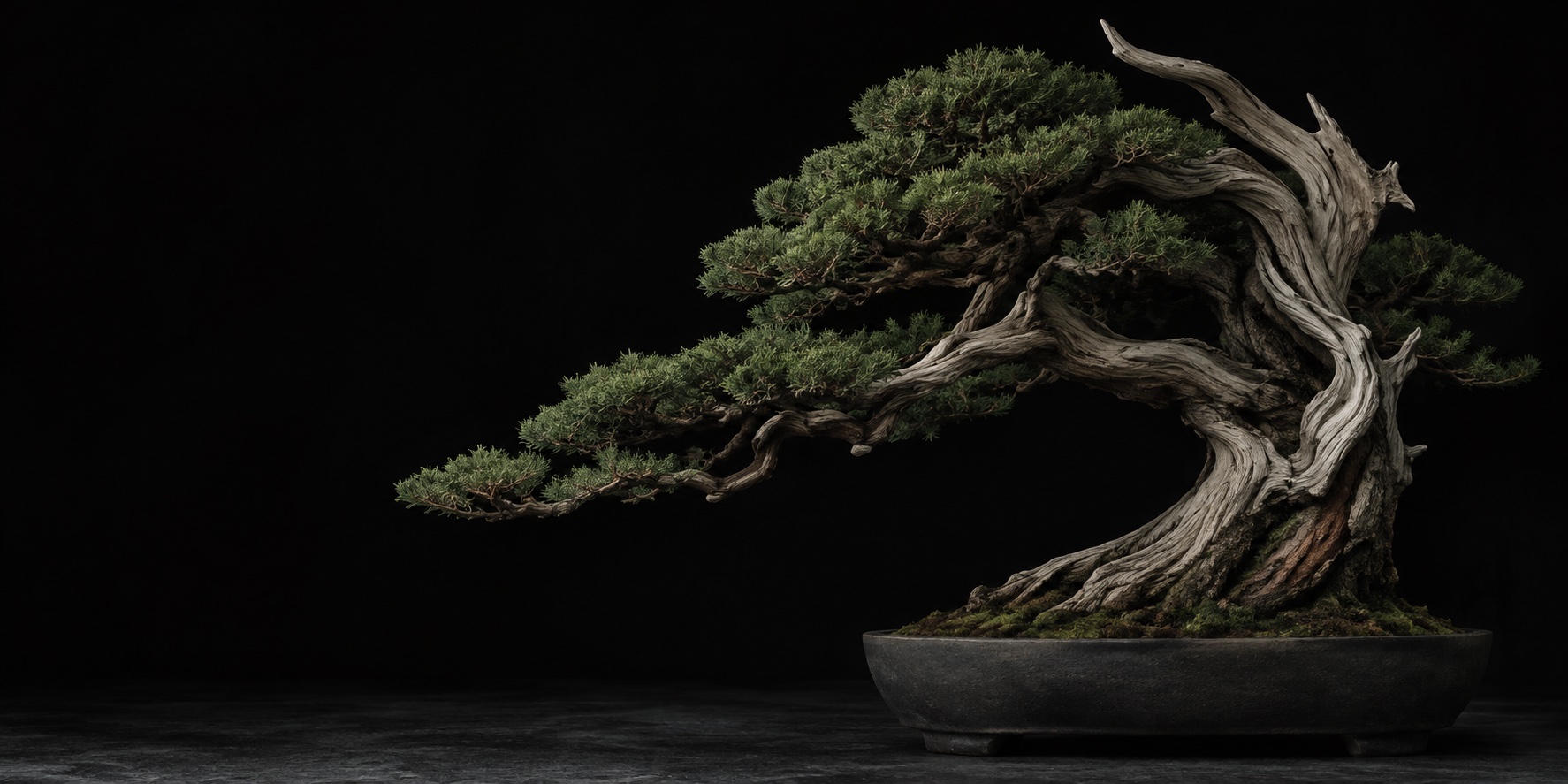
- Deadwood (jin and shari) raises contrast on the tree itself; the pot should get quieter, not louder, to compensate.
- Cascade and semi-cascade junipers break the sizing rules: they need deep, tall containers for visual and physical balance.
- Junipers are outdoor trees, hardy across roughly USDA zones 4–9 depending on species — they decline indoors, whatever the label says.
01 — WHY UNGLAZED
A dry surface
for a dry story.
Japanese convention puts conifers in unglazed pots, and the logic survives translation. A juniper's beauty is mineral: flaking bark, pale deadwood, foliage in dull blue-greens. A glazed surface — wet, reflective, colored — speaks a different language next to that. Unglazed clay shares the tree's own vocabulary of earth and age.
This is also why the great conifer pots come out of kilns famous for clay rather than glaze. Tokoname, formally designated a traditional craft industry of Aichi Prefecture and one of Japan's six ancient kilns, built its bonsai reputation substantially on exactly these quiet, iron-rich unglazed bodies.[1][2]
The juniper already owns the drama.
The pot signs the ground beneath it.
02 — FORM FOLLOWS STYLE
Match the pot
to the tree's force.
Junipers are styled across the whole range of bonsai forms, and the pot should track the style, not the species alone. The working matrix:
| Tree style | Pot form | Surface | Why |
|---|---|---|---|
| Formal / informal upright, aged trunk | Low rectangle, modest lip | Unglazed brown or grey | Horizontal weight answers the trunk without adding gesture |
| Severe, heavily angled trunk with deadwood | Strong rectangle, pronounced lip and feet | Iron-rich dark clay | The pot must not look weaker than the tree it carries |
| Lighter, younger material; soft movement | Sturdy oval | Unglazed grey-brown | An oval softens the composition while staying dry and quiet |
| Cascade / semi-cascade | Deep square or round, tall | Unglazed, darker tones | Physical counterweight and visual anchor for the falling line |
| Literati (bunjin) | Small round or nanban-style, shallow | Rough, primitive clay | A minimal pot keeps the single elegant line as the whole subject |
Matrix compiled by the JAPAN BONSAI EDIT editorial team from Japanese display convention and our own composition studies. An individual tree can overrule any row.
Deadwood deserves its own sentence. Jin and shari give the tree a built-in highlight — pale, almost white, against dark foliage. When the tree carries that much internal contrast, the pot should step one register quieter: darker, simpler, lower. Ornament under deadwood is double seasoning.
03 — SIZING
Measured, not
guessed.
Fits a juniper
- Length about ⅔ of tree height (uprights and slants)
- Depth close to trunk diameter at the base
- Width slightly narrower than the canopy
- Unglazed browns, greys, iron tones
- Deep tall pots — for cascades only
Rarely fits
- Bright or glossy glazes of any color
- Delicate, thin-walled feminine ovals under heavy trunks
- Shallow display pots on trees still building roots
- Ornate painted or carved decoration
- Indoor placement — the problem no pot can fix
When reading a seller's dimensions, confirm whether depth is interior or exterior, and remember that an unglazed pot runs visually smaller than a glazed pot of identical size — the dry surface absorbs light. If a juniper looks pot-heavy on screen, it will look worse on the bench.
04 — CLIMATE FIRST
An outdoor tree.
Entirely.
Junipers are hardy outdoor conifers. Retail and grower guidance places the common bonsai species across roughly USDA zones 4–9 — Juniperus procumbens 'Nana' is listed at 4a–9b by major US growers — and they tolerate hard frost when roots are protected.[3][4]
What they do not tolerate is living indoors. A juniper on a bookshelf fails slowly — it can look alive for months while it declines. Full sun outdoors, seasonal temperature swing, and winter rest are part of the species' metabolism.[4] Check your zone before buying.[5]
Outdoor placement → winter root protection → style → proportion → surface.
05 — THREE WAYS TO CHOOSE
Three honest
paths.
Not a ranking — three different relationships with the same standard.
Japanese Masterpiece
A signed unglazed Tokoname rectangle.
For conifers, the signed unglazed work of Tokoname kilns is the reference standard — iron-rich bodies that darken and gain depth over decades of watering.[2] Look for the maker's seal and crisp, unforced edges.
- Look for
- Maker's seal, tight clay body, clean cut feet, quiet lip
- Expect to pay
- US$300 upward for signed work; notable names and antiques far higher
- Where
- Specialist Japanese pot dealers — verify seals before paying collector prices
Local Artisan Choice
A stoneware rectangle fired near you.
Unglazed stoneware is well within reach of serious Western potters, and frost-safety matters more than pedigree for a tree that overwinters outdoors. A local maker's iron-toned rectangle serves the same aesthetic at lower risk.
- Look for
- High-fired, frost-safe stoneware; honest feet; generous drainage
- Expect to pay
- Roughly US$80–300 by size and maker
- Where
- Potters' own sites, bonsai club sales, specialist fairs
First Practice
A production unglazed rectangle, sized right.
A first juniper — often a procumbens 'Nana' — deserves a plain brown production rectangle and nothing fancier. Put the budget into winter protection and good soil; upgrade the pot when the tree has earned it.
- Look for
- Correct length (⅔ of height), real drainage, frost-tolerant body
- Expect to pay
- Roughly US$25–70
- Where
- Established bonsai retailers in your country — see buying bonsai online in the USA
EDITORIAL NOTE — JAPAN BONSAI EDIT currently has no paid or affiliate relationship with any seller named on this page. If that changes, links will be clearly disclosed. Our disclosure policy explains how we select products and label AI images.
06 — QUESTIONS
Asked, answered.
Can a juniper ever take a glazed pot?
Occasionally — a very dark, matte glaze under a refined shohin juniper can work. But if you are asking in general, the answer that keeps you safe is no. Unglazed is the convention for a reason, and departures need a specific tree to justify them.
What pot does a cascade juniper need?
A deep, tall container — square, round or hexagonal — that physically counterweights the falling line and visually anchors it. The ⅔-of-height length rule does not apply to cascades; depth takes over as the governing dimension.
Why did my indoor juniper die even though it stayed green for months?
Junipers can hold color long after they have stopped functioning; indoor decline is slow and quiet. They need outdoor sun, airflow and a cold winter rest.[4] There is no indoor juniper care routine that fixes this — it is species biology.
Does deadwood change the pot choice?
Yes — downward in volume. Jin and shari add strong internal contrast to the composition, so the pot should become darker, lower and simpler to keep the total number of voices at one.
Sources
- Aichi Prefectural Government — Tokonameyaki (Tokoname ware), designated traditional craft.
- JETRO — Tokoname bonsai pots (export profile, PDF).
- Brussel's Bonsai (US grower) — Green Mound Juniper, hardiness 4a–9b.
- Eastern Leaf (US retailer) — Juniper care information (outdoor placement, full sun, winter care).
- USDA Agricultural Research Service — USDA Plant Hardiness Zone Map.